
By Will Gilson, Currier Times Staff///
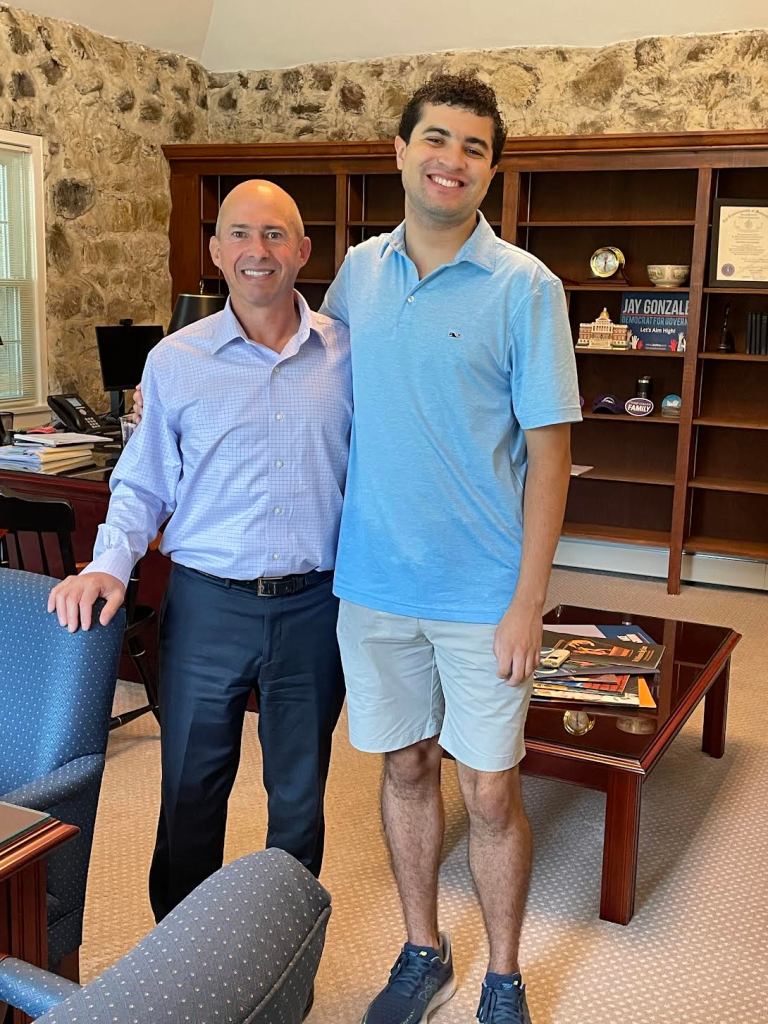
Editor’s Note: The following Question and Answer interview is being provided as a transcript, with some limited editing, from Currier Times reporter, Will Gilson’s, sitdown interview with Curry President, Jay Gonzalez.
1). Why did you pick Curry?
Well I have been, I had it in my head that I thought I might like leading a college or university. So I started looking around and I saw the posting for the new president position at Curry, and the first thing I did was look at the mission, and I loved the mission of the place. I loved what the place says is all about, helping to prepare students for career and life making them good communicators, and critical thinkers. The fact that it mattered that this is an inclusive, diverse environment and community of learners.
All those things really resonated with me and I was in a place in my life where I wanted to be a part of something meaningful. I know personally my college experience was transformative for me. This felt like the kind of place that would feed my soul in that way. Being a part of this type of community, and I’ve started looking at the posting and what the Board of Trustees said they were looking for in their next president, and it felt like a lot of my past experiences and skill sets matched up really well with
what they said they were looking for.
So even though I’m not an academic, I’ve never worked in higher ed before. I don’t have a Ph.D. after my name. I’m a very nontraditional candidate to be president of a college. I thought these guys might be looking for someone like me. And so I applied and I’m really grateful it worked out.
I’m thrilled to be here. I was thrilled to get the job every second I’ve been here in my almost six weeks on the job so far, it’s been very validating. I meet more and more people every day who care deeply about this place and learn a lot about things that are going on on this campus that I’ve been extremely impressed with.
The students are the best part, and so I’m so, I just feel so privileged to be here. To be part of this community.
2). What do you envision Curry from one year now to 5 years now?
Let me answer in terms of short term longer-term. So short-term, I hope a few things happen. One is I hope that students feel an even greater commitment to their success, and to their support, and efforts on our part as college administrators, faculty, others to strengthen the supportive, inclusive community that attracts so many students like you and that is one of the things that I think makes us special, and one of the things I love about this place.
I hope, even if in just small ways, students feel a renewed commitment and focus and genuine desire to make improvements there. A year you know short term I hope students see that and feel that and everybody in the community sees that and feels it.
There are a lot of things, you know I hope for within a short period of time. One other big one is that we finish developing a new strategic plan for the college. It’s been more than five years since the last strategic plan. We plan to launch a robust process with lots of participation from lots of stakeholders on campus with the hope of finishing a new strategic plan by the end of this academic year. That would be a blueprint for how we move forward together that hopefully through the process and the final product in the short term will be a way to really unify our whole community around a common vision and what we need to do. So short term that’s a big thing on my agenda.
Longer-term, five years from now, I hope we are doing an even better job at delivering on our mission, and
one of the things I’m really hoping we will move the needle on in a big way is the graduation rate. You know, only about half of our students graduate in four years. We got to do better at that. And that means better supports for students, ensuring that our programming here is relevant and keeps students engaged through graduation, and we’re keeping up with that. It means that we’re accessible and affordable for everybody, and we have work to do there.
So longer term, those are some examples of ways in which I’m really hoping we as a college are doing even better at delivering on our mission and we’ll never we’ll never get to the point where we declare victory and say we have done everything we possibly can do. There will always be room for improvement. But I’m
really hoping 5 years from now when we look back we’ll be able to say we delivered on the promise for our students in a much more impactful way and we have delivered for our students on the value proposition that we promised them.
That we are going to help them graduate and be ready for life and for their career and to be successful and that the investment they made and money and time and being in this place helped them grow, helped them develop in ways that were important to them. Made them feel a part of a really strong, supportive community, and that they belonged here and they’re better off for being here. I know that’s happening already. I want to make sure five years from now we look back, we can say we made a lot of meaningful progress and do an even better job at that.
3). How are you going to use your background in politics and law to advance Curry?
So, as I said I thought my experience lined up with what they were looking for in a new president. And I’ll say one of the things that government I think prepared me well for was the higher ed world because a college campus and college governance structure is very similar to state government. There’s no dictator.
Yes, I’m the president of the college, but I don’t get to make all the decisions about everything. There are a lot of invested interests. They’re the students who are the most important stakeholders on this campus. We’re here for students.
There’s the rest of the administration. There’s the faculty who obviously have a play of very strong role in governance on the college campus. There a lot of shared governance infrastructures in place. Committees that make decisions on behalf of the college. There’s the Board of Trustees. there are alums and donors who do have an interest in this place.
So, it’s very similar to government where the governor, the president no matter what level of government they don’t get to decide anything. There’s a legislature. There’s the public. There’s the voters. There’s the media who’s keeping an eye on people like you, and so you have to, the thing about it is you have to figure out if this is, you know we’re trying to get to some particular place or you know carry out some big initiative or solve some big problem.
What’s the path? Working with everybody else, where you can bring everybody on board and everyone can hold hands who needs to be part of it, to get as close to that place as possible. And you had to do that, I learned how to do that and do that in government, and you definitely have to do that at Curry College or any other college and it’s something I actually really enjoy.
So, that’s something I’m already very engaged in the processes here, and one of the things that I think my experience aligns well for what I need to do here. The other couple things I’d say is I’ve led large organizations and state complicated organizations and state governments. I was a cabinet secretary that oversaw the state budget and all kinds of state agencies. I had 3500 employees. I was overseeing a 32-billion-dollar budget at the time.
I also led health insurance companies that had a lot of employees and a lot of big challenges. A lot of complicated dynamics, and so in both cases I was in those positions during really challenging times, and this is a challenging time for any small liberal arts college. Less and less high school students are graduating from high school than used to be the case. Many more questioning what’s the value of going to college and
so there’s a lot of pressure on colleges and universities generally right now.
And we need to figure out how we’re gonna navigate that and and take Curry to the next level. And be successful in not just today but for tomorrow and so I think my experience in those other leadership roles is really helpful for informing my job here.
And lastly, I’d say as a candidate for governor, and in some of my prior jobs, I met a lot of people in the greater Boston area and in the state. I have a lot of relationships in the business community and in government and many communities here, and I think one of the things that could be really helpful for Curry is raising our profile with the broader community.
There are a lot of people not that far from here in Boston and elsewhere who don’t know about Curry, and we’re seven miles away, and there’s a whole world of potential partners for us. And, you know, companies that can provide internships to our students who may want to start innovative programs with us. A lot of opportunities to better serve our students here that I think we haven’t fully explored or tapped in, and I
think my background and network in kind of the greater Boston area in Massachusetts can be helpful for raising our profile and getting a lot of new stakeholders engaged and invested in supporting our students at Curry.
4) What is your favorite thing about Curry?
The students. Easily. I loved when. So I was here for about a month before students arrived, and I was getting antsy and then I helped with student the new student move-in which was really fun. Just getting to meet the students and seeing how excited they were to be coming and their parents who were crying as they were dropping off their kids and I was very involved during Welcome Weekend and since then, very intentional about going to some of the games and just going to the Stu and checking in on people at lunch,
and asking people how they’re doing and it’s been really great
Just the energy that the students bring. The aspirations they have. It’s just so inspiring and it’s been great to be around it’s engerizing for me and it’s a great reminder of you all are the reason I’m here and It’s been great and engaging with students. The other big reason is thing I love about Curry I would say is our values as a community, and the fact that we pride ourselves in being a supportive welcoming inclusive diverse community.
A caring community and I think that is, first of all, it’s something I think is not necessarily the case at a lot of other colleges and universities, and it’s definitely the kind of person I am and I want to be a part of a community that feels that way where people are engaging that way with each other.
And I know every community in the broader world here at Curry, everywhere there are times there’s a person or people who aren’t acting in a way that’s considered consistent with that values. But, I felt before I decided to come here based on what I had read and people I met, and it is definitely been validated since being here, that that is the overriding view of who we are. Who we want to be and who we strive to be. And I love that about Curry.
5). How do you hope to continue to build trust with students?
So I’d say three important ways. One is to listen to them. So, nobody knows better what we’re doing well or not well with respect to supporting our students and helping them be successful here than students.
So, I want to make sure my whole team is listening. Student input and listening to what we hear. So that’s a first step is asking, you know, engaging. I plan to, as I’ve said, I’ve already tried to get out and about and meet a lot of students. I’m going to continue to do that. I’m setting up a bunch of meetings with different student groups that scheduling now from the end of the year, and I’m gonna be people are gonna be sick of me.
Students are gonna be sick of me asking them how are things going. What are we doing well? What could we do better? What’s working for you? What isn’t because I generally want to know and I think it’s really
important for building building trust.
The other part is it can’t just be listening. It’s also the second thing is responding, acting– showing–that we are hearing students. And you know there’s gonna be a lot of stuff that students want I’m sure. That we aren’t gonna be able to do for whatever reason. There are constraints and limits about what we can do. But
there’s gonna be a lot that we can address. I’ll give you an example of one small way.
A student sent me an email and said that she’s an upperclassman, I think a senior. Said that she really enjoyed the daycare center that used to be the on that side of campus. There’s a playground there. And she said that she really enjoyed and it was kind of– these are my words not her words– but meditative time for her to go to the playground and swing on the swing.
And she said when she came back this year, the swing was gone. And she asked whether there’s anything and she said she was really upset by it because it was such a special place for her to kind of gather herself and, so I immediately called our director of facilities and a couple of other people to just ask why, and it turns out it was taken down because I think maybe some people were gathering in that area at night and there wasn’t you know, I don’t know if it was attracting people and they weren’t public safety patrols over there, whatever. But so we figured it out and the swing is back up.
And it’s this small way that we were responsive but there will be many other ways where a student’s experience maybe is not not great because of one thing or another. That doesn’t take much to address. And so we gotta be responsive and act. And the last thing I’d say to build trust with students is to be transparent.
You know this is your school, this place we are here for you. You have every right to know what’s going
on. I want to be more transparent. I want to create more opportunities to hear from students more opportunities to share with students and you know communication is the key to life and lots of respects so know the answer to this question in a nutshell is better communication both ways.
Categories: News
 The Currier Times